
UNDERSTANDING ENGLISH PLACES • LOCI
Understanding our towns can help us save our high streets
High streets are in many ways a reflection of their wider town, and their strength and vibrancy very much depend on the health and vitality of the town, its economy, service provision and interdependence with its surrounding area.
4 min read / September 2026High streets and towns
Many public investment initiatives and much political airtime has been spent on “saving” our High Streets and Town Centres. These include:
- Future High Streets Fund (2018-2021), originally launched with £675 million and later expanded to £1 billion, which supported 72 places across England1,
- Towns Fund and Town Deals (2019 onwards), a £3.2 billion programme supporting 101 towns across England2,
- High Streets Task Force (2020 onwards), established to provide expert advice, training, research, and capacity-building support to local authorities and town partnerships1,
- Levelling Up Fund (2021 onwards) with over £3.8 billion was allocated to date on town centre regeneration and associated transport, public realm and community asset initiatives2,
- Long-Term Plan for Towns (2023 onwards) marking a switch in focus from short term regeneration projects to longer term place-based programmes3.
Whilst there is some evidence that these programmes have generated some benefits in terms of town centre vitality and community outcomes, there is still a lack of strong longer-term evidence on their wider economic and social impact.
What’s more, councils, communities and stakeholders lack a consistent, comparable view of place, making it difficult to both properly evaluate investment, without temporal comparisons, and properly benchmark or potentially learn from other similar places and similar initiatives.
The need for consistent, comparable and temporal data on towns across England in terms of their individual functions, interdependences and needs is clear.
Understanding English Places
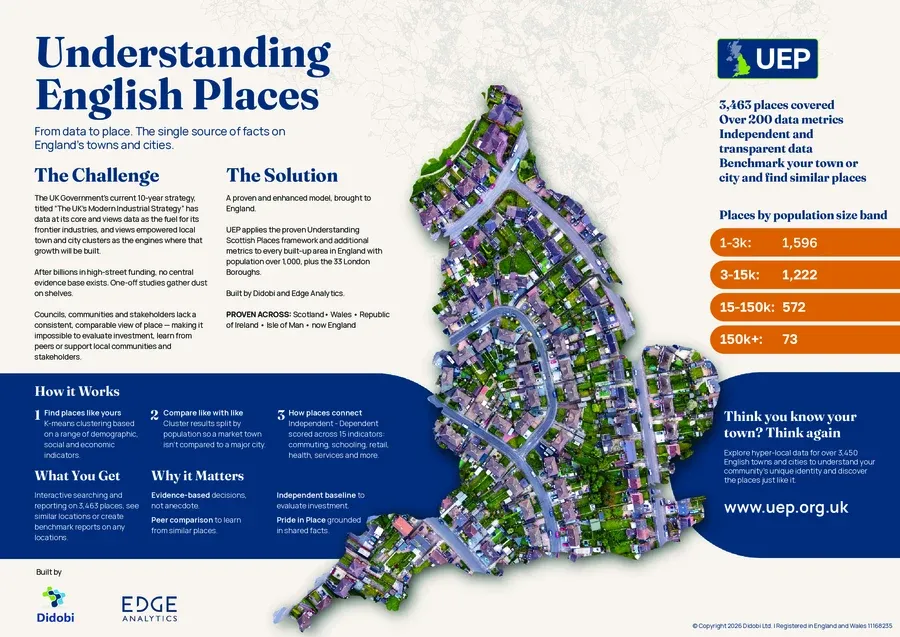
The Understanding English Places (UEP) Model (https://www.uep.org.uk) seeks to address this need. Jointly developed by Edge Analytics Ltd and Didobi Ltd, it is based on the framework and methodology of the well-established and respected Understanding Scottish Places (USP) Model (https://www.usp.scot/4). The UEP is driven by English data and configured to reflect the place assets and relationships of nearly 3,500 cities, towns and villages with a population over 1,000 across England.
UEP contains data that has been gathered, processed and combined from a range of Governmental and other Open Data sources and commercial datasets covering the demographic, social and economic profile of each place, its social and commercial assets and other diverse indicators including crime statistics, journey to work data, train station passenger counts, internet download speeds and deprivation.
Like the USP, UEP groups places into comparable clusters based on their demographic and socio-economic characteristics and size, as well as classifying places on their inter-relationship with and level of dependence on other neighbouring places for the provision of services and the functioning of their local economies.
UEP, which is accessed via an online portal, will allow local councils, communities and businesses to assess comprehensive, consistent, comparable and temporal data to assess the unique functions, interdependence and needs of individual towns, enabling more targeted and effective regeneration strategies.
As our colleague, Matthew Hopkinson (Didobi ltd) recently put it in his letter to the Financial Times on 24th August 20266.
“…high streets don’t create healthy towns; healthy towns create vibrant high streets. Only by having a detailed understanding of towns can you hope to save Britain’s high streets.”
It is hoped that UEP can play its part in helping to save our High Streets.
References
- Department of Levelling up, Housing and Communities (now Department of Housing, Communities and Local Government), https://www.gov.uk/government/collections/future-high-streets-fund (2021).
- Government Parliamentary Statement, https://questions-statements.parliament.uk/written-statements/detail/2023-10-17/hcws1072 (2023).
- Department of Levelling up, Housing and Communities (now Department of Housing, Communities and Local Government), Our Long-Term Plan For Towns, Department of Levelling up, Housing and Communities (2023).
- Understanding Scottish Places, https://www.usp.scot/.
- Financial Times, 2026.